
Recruit and Hire the Right People for Your Cleaning Business
I've talked often about the need to "Recruit" employees for your cleaning business -- not just hire warm bodies. But that's a tough thing to do these days with so much competition for great employees.
It's been said that your competitors can copy everything about your business -- except your people. And I believe that to be true. The people you choose makes a big difference in how your company is being represented. So if you make the wrong choices when hiring employees you are probably be setting yourself up for failure.
Here are Some Tips for Successful Employee Recruiting
First, create a profile for each position in your company, based on your best employees. Start by noting the key skills and behaviors they have that are needed for an employee to be successful in the position. Make a list of about 10 skills and behaviors. Here are some examples:
- dependability
- ability to prioritize
- enthusiasm
- cooperation and teamwork
- decision making skills
- honesty and integrity
- able to work under pressure
- initiative
- motivation
- oral and/or written communication skills
Once you have the list of behaviors you're looking for, make a list of interview questions based on these behaviors. So if you're looking for someone with integrity and honesty, ask a question like, "Have you ever seen someone take a piece of candy from a candy dish, or take something out of the trash that they could use? And if so, do you think that's ok and not a big deal?" A question like that can help to uncover whether or not they think that's an honest thing to do.
Always Be Recruiting and Marketing Your Job Openings
If you wait until you have an opening, then you'll always be short-handed and desperate for immediate help. Be creative with your job advertisements. Don't just say things like "Hiring cleaners, FT/PT, 9 - 3pm". Make sure they understand the true benefits your company has to offer. It's like marketing your company to your Ideal Client, but in this case you're marketing to the best employee candidates. Have an application on your website, and use social media to get the word out.
One way to figure out your company's true benefits is to ask your longer term employees why they stay. Besides the paycheck, what motivates them to come to work every day? Is it the camaraderie among the employees? If so, be sure to highlight that in your employment ad as a benefit for working for you.
Another recruiting tip is to do a video with your happy employees and put it on your website so the people applying for a job will see it. Ask them that question - "Why do you stay with our company?" Then let them talk on camera. Nothing will sell a job better than having your own employees tell why they love to work for you. When people see that they think that maybe that's a pretty good place to work!
One thing you can do to improve your recruiting efforts is to find out who is hiring your people away and why. If you're losing employees, find out why they're leaving and where they are going. If they found another job, find out if it's to one of your competitors, or if it's to another service industry like restaurants, or to retailers that pay similar wages. Get to the bottom of why they're leaving and where they're going. This may mean doing an exit survey or just asking a few questions when they give notice.
In a recent survey, we asked cleaning business owners to share the top two ways they find good employees. The #1 answer, coming in at 58% was Employee Referrals. Create an employee referral program by rewarding your employees for referring new employees. Then promote it to your employees as well as when recruiting new employees. Let candidates know they can receive extra cash for referring new employees. Most employers don't pay the reward until the employee completes the first 90 days of employment. But consider paying part of the reward immediately. If you're doing your due diligence, you should only be hiring people you're confident will stay. People will be more likely to refer if they know they can get some cash right away.
When planning your recruiting process, be sure to periodically compare your wages to the competition. But don't stop there. Also compare your wages against industries that compete for the same type of people you need, such as restaurants and retail establishments.
What to Include on Employment Applications
There are certain things you want to include on your applications. But be sure to check with your State to make sure your application follows state laws.
- One thing to include is a statement that certifies that the information is true and correct, and false statements are grounds for denial of employment or dismissal. This keeps the applicant honest and protects you from hiring based on statements that you later found out to be false.
- Declare that the application is not an employment contract.
- Declare that you have the right to fire with or without cause, keeping in mind that this statement is subject to your state laws.
- Get authorization to check references and do a background check. Have a release of liability for the reference or firm supplying the background information.
These things will all help to protect you from negligent hiring lawsuits by employment candidates.

Telephone Screening - Use Qualifying Questions
Qualifying Questions are the questions that will help you determine if the candidate is worth bringing in for an in-person interview. Screening applicants by phone will help you save time because you'll be asking a few targeted questions to qualify them for the position. For example, if you offer weekend services and it's a requirement for the job, ask them if they can work on Saturdays. Another qualifying question you might as is "What are your wage requirements?" If your candidate expects to make $25,000 a year but they'll only make $18,000 a year with this job, you'll want to know this right away. There is no point in talking to someone if they have certain requirements you can't meet. You might also ask, "Where were you previously fired from and why?" If they say they've never been fired then ask why they quit their last job.
In-Person Interviews
When you bring candidates in for interviews, ask your questions in a way that gets the person talking. "Tell me about a time when..." With this question they have to put themselves into the situation that they were in, when working at a previous job. For example, "Tell me about a time you worked on a project that failed." With this type of question you want to see if they accept responsibility for the project failing, or if they're going to blame others. Another question that gets them talking is, "Explain to me how you would handle this situation". That puts them into a difficult situation, and helps you see if they are able to solve the problem.
When interviewing candidates with "cleaning experience", you might want to test their abilities. One way to to do that is to observe the candidate under simulated or real work situations. For example, you could observe them cleaning a bathroom, or dusting the room. You might also use hypothetical situations when interviewing them. Describe a common situation and ask how they would handle it.
A good interview should take 30-45 minutes. But what do you do if you know within the first 5 to 10 minutes that they're not the right person for the job? You don't want to waste all that time interviewing the person, but sometimes interviewers just cut it short and say something like, "Thanks for coming, we'll get back to you." That can be misleading if they think they have a chance at the position. Instead say something like, "I've already interviewed several people, and I can see that you're really not going to be a good fit for this position." It's a way to get out of doing the complete interview, and it lets them know you won't be considering them in the future.
Do you do second interviews? It's a good idea. The way most companies do it is to have each interviewer ask a different set of questions. But we've had good luck with asking the same questions, and then we collaborate afterwards on our perceptions of how the person answered each question.
Reference Checks - Don't Skip This Step!
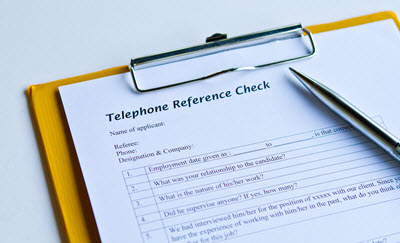
Many employers skip doing reference checks because they think no one gives them any more. But if you ask the right questions, you can learn a lot about a person's work history.
The first step is to tell the applicant something like this, "I can't hire you without a reference check. So what I would like you to do is call your reference and set up the phone call with me. Here are the days and times I'm available." This ensures that the person they list as a reference is expecting to get a reference check call, and they'll be more prepared. It also helps to make sure you can get on the phone with them instead of playing phone tag.
Tips for getting references:
- Ask this question in this specific way. "Would you rehire this person? Yes or No."
Be sure to add the Yes or No at the end because they'll be more likely to actually say, Yes or No. - Some people are afraid to talk negatively about an applicant because they're afraid of a law suit. So one thing you could say is, "I'd like to discuss just the positive aspects of this person". Try that to see if you can get them talking because people aren't afraid to talk about the positive aspects of others.
- Here is another one: "I noticed that you are a little reluctant to talk about Joe. Is that true? Yes or No."
Again, add the Yes or No, as they'll be more likely to answer. Then probe deeper and ask, "Should I do a background check on this person?" They may answer that question without revealing anything negative about the person. - Probe for negative traits by asking, "Are there any weaknesses that this person needs training in?" It's a way to get them to say, "Yeah, they could use training in such-and-such".
Common Mistakes Made by Interviewers
- The most common mistake I see people make is doing too much talking and not enough listening. Many of us fall into that trap. We start the interview by telling them all about our business and all about the job. After 10 minutes, the candidate has barely spoken! The 80/20 rule applies here; we should be listening 80% of the time and talking 20% of the time. You've got plenty of time after you've let them do all the talking, to tell them all about the job and the company.
- Another mistake people make is giving too much information about the perfect candidate. You say something like, "Here is what we're looking for -- someone that's gets to work on time, someone that's hard-working and diligent, someone that wants to work this particular shift." So you've just given them all the answers! That means when you start asking more questions, they're going to tell you exactly what you want to hear. So don't give too much information on the type of person you're looking for.
- Sometimes you might find yourself helping the person respond. If they're stumbling with their answer or English is their second language, you might try to help them get through it. When you do that you're basically answering questions for them. So don't help them with their responses.
- Another mistake - making quick judgements. Someone comes in with sweaty palms and you make an immediate judgement that this isn't the kind of person you want to hire. Or maybe they've got a purple streak in their hair and too many ear piercings for your liking. That doesn't mean they wouldn't be a great employee so don't be too quick to make judgments.
- Another mistake is not even knowing the job requirements. Maybe YOU know the requirements but your supervisor who is doing the interview doesn't. This goes back to the beginning and creating employee profiles. Make sure that whoever is interviewing knows all of this.
Common Selection Problems
- The first common selection problem is that you missed getting critical information during the application/screening process. Maybe you didn't ask them if they had transportation and you later find out they're relying on friends to drop them off so they're just not reliable to make sure they get to work every day.
- You misinterpreted or misunderstood the information. If you're hiring people from different nationalities you know there are a lot of cultural differences. So if you don't understand these things, you could have some selection problems.
- Making decisions based on biases or stereotypes. You must be impartial and treat everyone fairly.
- Making your decision too quickly. Do not hire out of desperation because it usually means you're going to hire people against your gut feeling. So take the time you need to interview them properly, do your due diligence by doing second interviews and reference checks.
Recruiting and hiring can be a tiresome process, especially if you have a problem with high employee turnover. One of the best ways to improve your turnover rate is to hire the right people in the first place. Take the time to implement these tips and incorporate them into your hiring process. Then stick to the process no matter how difficult it may seem. You'll be glad you did when you discover you're hiring better quality employees who are making your life easier.
How to Hire *STAR* Employees for Your Cleaning Company
Building a dream team begins with finding the right people who will become exemplary workers and this begins with your hiring process. If you find yourself asking these questions; "I can't find decent employees" or "Why do employees quit right after I get them hired and trained” or "What does it take to find employees that want to work and do a good job?" then this webinar is what you have been looking for.
To learn more about this system and purchase, visit our store