Cleaning Chemicals - Conditions That Affect Performance

Are you and your team getting the most from your cleaning supplies? Too often, technicians rush from task to task without letting the tools and chemicals properly do their job. We frequently hear from house cleaning company owners who get inconsistent results despite using the same cleaning materials each time.
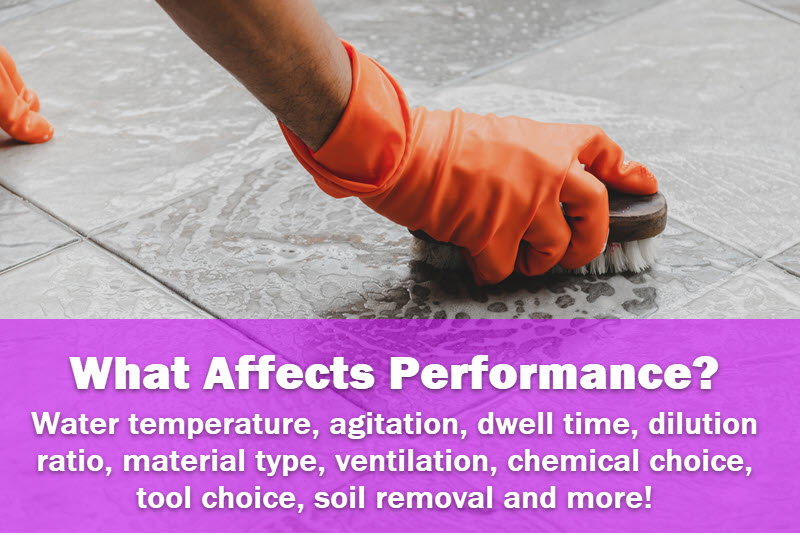
Common issues that cause inconsistent performance—and that cost you in the form of wasted time and energy.
Water Temperature
One of the most common mistakes residential cleaning technicians make when diluting concentrated chemicals is using water that's too hot or too cool for the job. For example, cleaning a vinyl floor that has a finish applied, requires a neutral pH floor cleaner mixed with cool water. Hot water can cause costly damage to the finish.
Generally speaking, you want to use cool water for general cleaning. But some types of solutions are more effictive with warmer water. Read the manufacturer's instructions to find the best temperature range for your applications.
Agitation
Spraying and wiping generally won't properly clean. Most messes require more agitation. Dirty grout between ceramic tiles, for example, will never come clean from a simple wipe. A grout brush can provide the agitation you need to get the job down. If your budget allows for it, a slow-speed floor machine with a nylo-grit brush can do the work with less wear and tear on your workers.
Dwell Time
Most cleaning chemicals don't work instantly—they need time to properly clean or disinfect a dirty surface. That said, you also shouldn't let a cleaning solution dry out on the surface.
Read the manufacturer's guidelines for usage. Some chemicals are more effective the longer they sit. Others risk damage to the surface if they stay on too long. Dwell time is especially important for disinfectants and sanitizes. If you're expecting the chemical to kill germs and bacteria, you need to give it time to kill all the germs and bacteria.
[Members can help employees with these tough issues using our “Learn to Clean Any Surface” ebook. Get it here.]
Dilution Ratio
Very few cleaning agents work with the same effectiveness no matter the concentration. If you're seeing inconsistent results from one of your solutions, check that you're diluting it with the correct amount of water as recommended by the manufacturer. This is especially important with disinfectants and sanitizers expected to kill germs and bacteria.
A solution with a higher concentration of water may require unnecessary scrubbing and take up valuable staff time. A solution with too high a concentration of cleaning chemicals is unnecessarily harsh on the surfaces you clean. Once you find the right mix, write it down in your procedures.
Material Type
This one may seem obvious, but it's worth mentioning. When selecting a cleaning chemical, some technicians forget to consider the material type. Some choices are a no-brainer (ie, glass cleaner for glass), but metals, wood, and plastics all have different chemical needs. Just because a cleaning chemical can clean a surface doesn't mean it's the most efficient choice.
Ventilation
A room must be well-ventilated when techs are using chemicals that give off strong fumes. Ventilation is also an important factor when cleaning floors or carpets.
If floor surfaces are allowed to stay damp, you may find yourself dealing with additional problems like mold or mildew. And hard floors need good ventilation so they dry before the cleaner (or the homeowner's pets) need to walk through the area.
Soil Removal
Some cleaning tools don't remove soil, but only spread it around. Depending on the type and amount of soil, have your cleaners use microfiber cloths or a vacuum with a HEPA filter. These products are designed to prevent spreading fine particles back into the air.
Chemical Choice
It's important to analyze the type of mess before applying chemicals. Again, just because a cleaning chemical can clean a surface doesn't mean it's the most efficient choice. For example, an all-purpose cleaner can clean a dirty stovetop, but you'll find a degreaser or a citrus-based solution far more effective (and quicker as it requires less scrubbing).
Tool Choice
Does everyone who cleans for your business know when to use a scrub brush vs. a cotton cloth? A common reason for inconsistent results is when cleaners are allowed to choose the tools they like best.
An easy way to get your crew on the same page is using color-coded tools for specific tasks, no matter which house they are cleaning. For example, one color of microfiber cloth for kitchen counters and another for bathroom counters, a specific color microfiber cloth for dusting, and so on.
Continue these designations until you have a set tool for every task, and make sure to communicate these procedures to your staff.
Equipment
There's a tool out there for almost any difficult cleaning task, but not every cleaning company finds it cost-effective to own an automatic scrubber, air purifier, or carpet steamer. Sometimes, it may be worth the cost to rent a machine to make things easier (and faster) for your team.
The simplest way to decide if you should rent a piece of equipment for a one-off job is to estimate how long the job will take to complete by hand vs. how long it will take with a rented tool. If the savings in staff wages cover the cost of the borrowed tool, it's an easy decision. If you find yourself needing to rent the same tools over and over, it might be time to consider buying.
Knowledge and Experience
One of the most important factors that influence cleaning performance is the knowledge and experience level of the technician. You can't expect a new technician to work with the same skill level as your most experienced cleaners.
Your employee training plan is the best way to bridge the gap. Also helpful is pairing new and experienced cleaners together. If you create this sort of mentoring program, however, make sure your veteran techs don't feel like they have to work harder to make up for their partner's inexperience.
There are so many factors that can affect the performance of your cleaning supplies. Review your procedures regularly to make sure your team is able to use their time wisely.

Attention non-members.
Understanding your competition and having readily available business information at your finger-tips, 24-7; will help you avoid the road blocks to running a successful home cleaning business. Becoming a member of MyHouseCleaningBiz.com can do just that! You will have access to hundreds of downloadable forms, eBooks, audio recordings and transcriptions, profitable bidding calculators, private online discussion forum, and member only discounts to everything in our online store, and much more…..
MyHouseCleaningBiz.com is a private, members-only resource for those serious about starting, improving and growing a profitable residential cleaning business. Within the private, members-only area, you'll find a huge selection of in-depth information that you won't find anywhere else on the Internet.