Measuring ROI of Vacuums for Housecleaners

Whether you have one employee or hundreds, buying equipment is a represents a big investment in your company. The biggest-ticket item most house cleaners buy is the vacuum, which can cost hundreds or even thousands of dollars. If you're shelling out that kind of money, it's important to choose wisely.
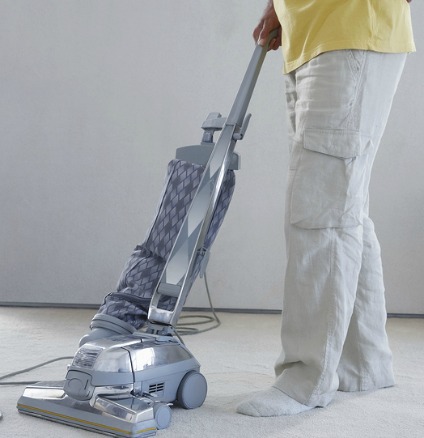
When shopping for a new vacuum (or fleet of vacuums for a large crew), it's wise to find a balance of these four factors:
-
Initial cost: Compare price tags across manufacturers to make sure the item you're considering is in line with averages. But remember, price and cost are not the same thing. Other benefits should factor into your decision as well (tech features, lifespan, green factor, etc.).
-
Productivity: Evaluate a vacuum's effectiveness and efficiency—how well and how quickly does it perform? Cheaper isn't better if the machine doesn't produce labor savings.
-
Lifespan: Most vacuums have a useable life of 2 to 5 years. This number can go much higher with a quality maintenance program. Ask your supplier or the manufacturers for the average lifespan of the equipment you're considering.
-
Operating cost: How much will this particular vacuum cost (or save) when it comes to things like energy consumption?
In a labor-intensive industry like house cleaning, where manhours make up 55 to 85 percent of a company's budget, productivity is paramount. The right vacuums can make your team more efficient and effective, and can even allow you to reduce or redeploy labor hours.
Just remember: The best choice isn't the vacuum with the lowest price tag, but the one that delivers the best payback period and return on investment (ROI).
Know Your Numbers
Before you can calculate payback period and ROI, however, you need to know the square footage of the homes you clean. You can get this from the homeowner or by physically marking it off with a laser tape measure. You also want to break the square footage down further to carpet vs. other flooring so you know exactly how much vacuuming you do.
After figuring out the size of the spaces you clean, calculate your production rates. How long does it take to vacuum the spaces with the machine you currently use? You can do this yourself (see next paragraph), you can find industry averages in ISSA's 612 Cleaning Times, or you can use a software program from a manufacturer or industry association.
To calculate rates yourself, measure an area and clean it at a normal pace. Now, extrapolate the average time it takes to vacuum 1,000 square feet.
Calculating Payback Period
An important metric to understand is “payback period.” This is the length of time it will take to recoup the investment in a vacuum (via productivity gains/labor savings). The lower the number, the better. This calculation is simple. Divide the vacuum's price tag by the labor savings.
As an example, let's look at a backpack vacuum with a 12-inch carpet tool vs. a traditional 12-inch upright.
The average cleaning time for the upright is 26.8 mins. per 1,000 SF (or 2,239 SF/hr.) and for the backpack it's 8.25 mins. per 1,000 SF (or 7,273 SF/hr.). If you use one vacuum to clean 10,000 SF/mo., it would take 4.46 hours with an upright or 1.37 hours with a backpack. The backpack would save 3.09 hours/month or 37 hours/year. If your average cleaning technician's hourly wage is $15, then that backpack saves $556/year.
To determine the payback period, divide $556 (annual savings) by 12, which equals $46. Now divide $400 (the initial cost of the backpack) by $46 to get the payback period of 8.7 months.
In this scenario, the vacuum goes from costing you to saving you money after 9 months.
Calculating ROI
Once you recoup your initial investment (payback period), any additional labor savings are the ROI or how much you save by investing in a piece of equipment. The higher the number, the better. To determine ROI, you compare how long it takes to perform a task from start to finish with your current equipment vs. the product you're considering purchasing.
Start by subtracting the labor hours required for the new vacuum from the labor hours required for your current tool. This is your labor hours saved (use this to determine annual labor savings). Now, use this formula: Multiply annual labor savings by the vacuum's expected lifespan. Then subtract the initial cost of the vacuum as well as maintenance costs (annual costs x lifespan).
In the case of the backpack vacuum vs. the upright, to determine ROI we multiply $556 (annual labor savings) by 5 (lifespan in years) to get $2,781. Then subtract $400 (initial cost) and $720 ($60 annual maintenance costs times 12) for a total ROI of $1,661.
In this scenario, every upright vacuum you replace with a backpack will save you $1,661.
If all of this math seems overwhelming, don't worry. You can download our free ROI Calculator here and simplify the process.
Using the Data
Fully assessing ROI and payback periods may
reveal that a vacuum with a big price tag will actually pay for itself sooner than expected. Those savings, however, are only fully realized if you maximize the resulting labor gains.
Too often, owners of house cleaning companies buy more productive equipment but fail to make any labor adjustments. In a world of shrinking budgets and increased competition, you simply can't afford to make that mistake.
If a new backpack vacuum cuts labor by 4 hours a month, for example, you should reallocate (or reduce) staffing accordingly. That represents one hour each week that could be used to do detail work that there previously wasn't time to tackle. Or, it's one less hour each week you need to pay for additional workers.
Taking the time to calculate payback period and ROI can clearly illustrate the potential savings of a new piece of equipment, especially a big-ticket item like a vacuum. These simple calculations can be the difference between buying blindly and making an informed decision about the equipment you use.