Steam Cleaners and What NOT To Use Them On
We had a few questions about “steam cleaners” in the discussion forum and Rick Hoverson from Advanced Vapor Technologies gave a very detailed answer that we didn't want to lose in the forum so we're posting the article here.
Question:
Now that steam cleaners are the rage, reports of damage to various surfaces are beginning to surface. I'm wondering if heat can soften protective finishes on hardwood floors and how the moist heat it might affect adhesives on linoleum and vinyl tile floors.
Answer:
Your question is a good one and is necessary in researching whether or not a steam vapor system may be of value to you. This question can be compared to trying to define what is meant when using the word ‘clean'. Ask five different people and you are likely to get five different answers.
However to keep this as short as possible, it will be necessary to speak in generalities, for which there will be exceptions.
Frequently the term of ‘steam cleaner' is used when discussing the use of a steam vapor sanitation system. If you happen to still possess a Yellow Page directory and look for “steam cleaners” you will find everything from pressure washers, hot and cold varieties, up to and including carpet cleaning equipment/companies promoting what they do as ‘steam cleaning', when in fact there is no actual steam involved with any of these processes – maybe hot water on a good day! Not a good way to clean, especially on the interiors of homes or offices.
These items use and operate with a high volume of water, hot or cold, to accomplish the removal of unwanted soil from a surface. The amount of water consumed through the operation is usually notated in ‘gallons per minute' – a great deal of water! This is the concept that often comes to mind when discussing ‘steam cleaning' with people unfamiliar with a steam vapor system, which operates with minimal amounts of water defined in terms of ‘a quart per hour', a significant and defining difference. Hence, the effort to use a more distinct terminology to describe the process when considering the use of a ‘steam vapor system or device', so that we better define the physical parameters involved.
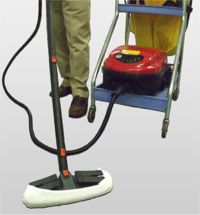
A steam vapor system operates with a different set of parameters than a ‘steam cleaner'. A steam cleaner uses the kinetic energy of water hitting a surface, whether hot or cold, to dislodge soils. A steam vapor system uses the energy of ‘heat' and light agitation to do the work. This is accomplished by trapping high temperature, low moisture, low pressure, steam vapor at or on the target surface through the use of special tools specific to a particular cleaning application.
Because heat and moisture are involved, it is necessary to consider whether the subject surface can tolerate the heat that may be in excess of 220 degrees F without sustaining damage – the crux of your question. With that in mind, we know from experience that some surfaces may be subject to more degradation from heat and moisture than others. Knowing the attributes of the steam vapor system (svs) you intend to use and how to vary those basic and powerful soil removal characteristics, is primary to being successful in using such a system.
This brings us to the type and quality of the svs itself, the type and quality of steam produced, the capabilities available to vary the amount or volume of steam being applied, the style and functionality of the various attachments suitable for a variety of applications that might be encountered when there are many different types of surfaces to consider, and most important, receiving some level of training for the user. This training can be self generated and developed through success/failure outcomes, or provided by support materials like manuals and dvds, or by a knowledgeable supplier through ‘hands on' training including after market support.
There is a learning curve associated with the proper use of a svs just as with any other piece of power equipment. When used improperly or inappropriately, damage can be an undesirable result. The more you use the system, the more efficient and effective you will become. When in doubt about a particular surface, one should do a small test in an unnoticeable or inconspicuous area before application, just as you would do with any process that might questionable as to the desired outcome.
Technique is also important and separates the novice user from the professional user and comes from training and product use. Several examples of this would be: wallpaper – you can clean it or remove it – it is a matter of technique used; painted surfaces can be cleaned or paint removed - a matter of techniques applied; raw wood surfaces can be cleaned and renewed or degraded depending on technique used; living plants can be refreshed and renewed or totally destroyed (as in the case of unwanted vegetation such as weeds or moss) depending on technique applied; glass window panes can be thoroughly cleaned or broken depending on technique; leather surfaces can be renewed/cleaned or made to shrink and crack depending on technique used to treat them. We could fill pages with such anecdotal examples. The point is that training and experience can be important along with knowing how to control the system to reach the desired outcomes.
There are some areas where one would not want to use a svs such as fine silks, finely finished wood furnishings, anywhere where temperature differentials would create internal stresses and lead to damage such as cold glass surfaces, surfaces that may readily expand when treated, such as excessive treatment of aluminum window frames. Very thin plastics can be deformed by too much heat as can some synthetic velour upholstery materials. Consider that you are using heat and moisture, and be cautious when such applications may endanger the integrity of whatever it is that you may want to treat and clean.
As regards hardwood floors – if properly used, a svs is an effective way to keep them clean and beautiful. I have personally used a svs for the past 15 years on my hardwood floors without damage or finish degradation.
As a final thought, I applaud you for asking your question, as it is a step in learning more about a truly remarkable, sustainable, non-toxic system that promotes the welfare of all human kind.
Rick Hoverson
Advanced Vapor Technologies
http://www.advap.com
www.myhousecleaningbiz.com/members/forum/openforum.cfm?forum=1"> |
www.myhousecleaningbiz.com/members/forum/openforum.cfm?forum=1">Thoughts or comments? Please consider posting them to the discussion forum