What Your Clients Are Looking for in a House Cleaning Service: How COVID-19 Has Changed Your Customers' Needs

Although most people understand that COVID-19 is primarily spread through airborne droplets of the virus released when people talk, sneeze, or cough, they are still concerned about surface contamination. In the early days of the virus, many people wiped down their groceries or sequestered their mail before bringing it into the house; they sang “Happy Birthday” or “Twinkle Twinkle Little Star” as they energetically scrubbed their hands for the recommended 20 seconds. Many families even decided that they could do without their cleaning companies for a while as they tried to limit the number of non-family members entering their homes.
Those days are not completely gone, but after vaccines became widely available, most people relaxed many of the most stringent precautions they put into place at the beginning of 2020.
People may not be disinfecting their groceries before putting them away anymore, but they are still extremely conscious about keeping surfaces clean and germ-free. According to a report cited in Forbes Magazine, the amount of money each consumer spends on cleaning supplies each month has increased 12% over the past two years.
Residential housecleaners are more in demand than ever before.
Because of your customers' increased awareness of COVID-19 and other viruses, you will need to reassure them that you and your employees follow rigorous protocols for cleaning, disinfecting, and training.
You need to have a COVID plan because:
- You want to help prevent the spread of any viruses.
- You will lose business if your competitors seem to be more on the ball than you are when it comes to health and safety precautions.
- You need to keep your employees safe for obvious reasons, but also so that you don't have to contend with the chaos of sick days and upended schedules.
Your four-pronged COVID plan:
1. Protocols for cleaning and disinfecting:
- The CDC clearly states that the virus causing COVID-19 can land on a surface and then be spread when someone touches that surface and then touches his nose, eyes, or mouth. Sanitizers alone are not sufficient to fight COVID-19. This may lead you to believe that disinfectants are the way to go. Not so fast! You can't disinfect a dirty surface without removing the dirt first. According to the CDC, the difference between sanitizing and disinfecting is that sanitizing reduces germs, but disinfecting kills them. You can read more details about this in our article, Sanitizing vs. Disinfecting: What's the Difference?
- One possibility is to use tools such as disinfectant foggers or electrostatic sprayers to strengthen your disinfecting measures.
- Whenever possible, allow for ventilation and air circulation.
2. Procedures and PPE:
- It's up to you whether you want to require that your employees be vaccinated against the virus, but many homeowners will want to know the vaccination status of your staff before feeling safe about allowing them in the home to clean.
- The CDC reports that unvaccinated adults are 3-5 times more likely than vaccinated adults to get infected from the Omicron variant. If that isn't convincing enough, consider this: adults who are fully vaccinated (with booster) are 97% less likely to be hospitalized with COVID-19 complications than those who are unvaccinated.
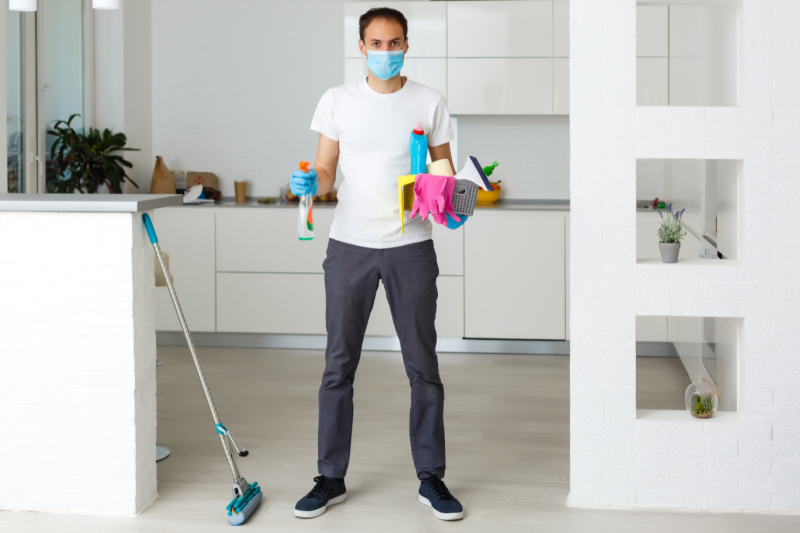
- Many states are beginning to relax indoor mask mandates, but homeowners who are concerned about the virus will appreciate it if your cleaners are outfitted with the appropriate personal protective equipment. This may include gloves as well as masks.
- One study found that respiratory drops and aerosols traveled 4 feet when people without masks coughed, 2 feet when participants wore cloth masks and less than a foot when they wore surgical masks. N-95 and KN-95 masks are even more effective than surgical masks at preventing the spread of the virus, but they are more expensive than surgical masks.
- Have a clear policy for sick days. This is a difficult tightrope to walk; you don't want your employees to call out frequently, but you do need to establish an environment where anyone with a scratchy throat and congestion (early symptoms of the Omicron variant) will either get tested or stay home for the safety of others.
- Some of your clients may feel more comfortable leaving their home while it is being cleaned. Others may stay in one particular room (a different one each time) and ask you to skip that room.
3. Preparation:
- Your cleaning technicians need both training and retraining on all COVID-19 cleaning procedures.
- For example, disinfectants need time to sit before they are wiped. This period where the surface remains wet with disinfectant is called either dwell time or contact time and is generally 10 minutes.
- Training procedures would allow for dwell time and make sure that cleaners do something else while the surface dries on its own to use time efficiently.
- If you use concentrated products, retraining is especially important so that manufacturers' instructions are carefully followed for correct dilution ratios.
- It can be beneficial to have your experienced employees actively mentor the new hires. That way, there is on-the-spot advice and support.
4. Perception:
- You may have done a perfectly wonderful job of training your employees and establishing safe procedures, but that won't mean anything to your clients or potential clients unless they know about it.
- Explain in clear detail exactly what you and your residential cleaning business are doing to prevent infection.
- Make sure that this information is on your website, plus on any social platforms you use, such as Facebook and Instagram.
- Photographs of your cleaning technicians disinfecting in masks will drive home the point that you are committed to keeping your customers and employees safe.
The Infection Control Training: Cleaning and Disinfecting Training Program Has Third Party Assessor Verification To ensure the information provided in this program is to industry standards, MyHouseCleaningBiz.com has had this program reviewed by a Cleaning Industry Third Party Assessor. He is a long-time veteran of the cleaning industry and currently an assessor for ISSA - CIMS & CIMS-GB Certification, and a third-party custodial effectiveness auditor of buildings applying for or being re-certified in the LEED standard through USGBC.
The Infection Control: Cleaning and Disinfecting Training Program meets Certification Requirements.